
Reflections on the 2026 Integral Conference of North America (ICON)
By Said Elias Dawlabani, first publish on Substack June15, 2026
One of the most exciting developments in Ken Wilber’s integral community in the US was the revival of the Integral Theory Conference after a decade-long hiatus. My friend Tom Habib spearheaded this revival in 2024, championing the diversity of voices contributing to a comprehensive integral vision of the future. Committed to bridging the divide between the Wilberian and Gravesian communities, Tom invited several Gravesians, including myself, to the 2026 conference. It was delightful to reconnect with old friends and colleagues and meet the younger generation of Wilberians and Gravesians engaged in various projects advancing the understanding of the human condition. The theme of the conference was the role developmentalists play in defining a post-tragic future.
While I believe every keynote and workshop were memorable, I will briefly comment on those that completed the integral circle by addressing the Lower Right Quadrant (LRQ), which, in the integral model, represents social systems and the environment. In the Gravesian model, the LRQ is the dynamic part of the model, the sungear determining the movement of all other gears in the system. It is the source of change that triggers higher psychosocial intelligence to solve more complex problems. Therefore, it was no surprise that many attendees were eager to shift focus from exclusive spiritual and personal growth to real-world challenges and understand how these solutions align with our respective models.
Geopolitics
One of the most intriguing presentations in the politics category was made by Bence Ganti, a clinical psychologist and founder of the Integral European Conference (IEC). As a Hungarian native, Bence guided us through Hungary’s developmental stages, warning of pitfalls modern democracies might encounter. By meticulously mapping Viktor Orbán’s 16-year regime of oppression and authoritarianism, Bence illustrated how this plunged the country into hopelessness and shame. He questioned whether the situation was tragically immutable—that change was impossible, that Orbán was unbeatable, and that development was regressing. However, he detailed the rapid transformation of the system as Hungarian citizens reached a breaking point. (This state of despondency is one the US is at least a decade away from). Bence described how anger and absolute defiance made this change possible, culminating in a two-thirds parliamentary victory for a new political force that challenged the global autocratic trend and indicated a developmental course correction. The images and clips he shared depicted a contagious euphoria not just in Hungary, but across the European Union and beyond.
The lesson is clear: any leadership adhering to a strongman mentality that negates social progress will be short-lived. The focus must shift to how we can shield our institutions from such leaders or mitigate downshifts with minimal pain.
Peace & Governance
While Bence’s presentation focused on existential issues affecting national, regional, and global geopolitics, other talks addressed even larger global issues. My longtime friend and colleague, Dr. Darrell Gooden, conducted an interactive workshop on the challenges of the Digital Age. Darrell began with the question: What happens when peace erodes to the point where the capacity to coerce surpasses the capacity to relate? As a military and digital expert, he explained how this critical boundary is now encoded in algorithms, automated through hybrid state–technocratic surveillance systems, and deployed across military networks in ways that surpass every ethical and legal framework designed to govern them. He then introduced the Peace Architecture Model (PAM) from his upcoming book. PAM is a developmental systems framework that maps four recursive layers of relational capability: interior integration, relational holding, field coherence, and functional institutional design. These layers parallel the architecture of the AQAL model, emphasizing the Lower Right Quadrant (LRQ) as the source triggering our response to existential threats.
The Nature of Change
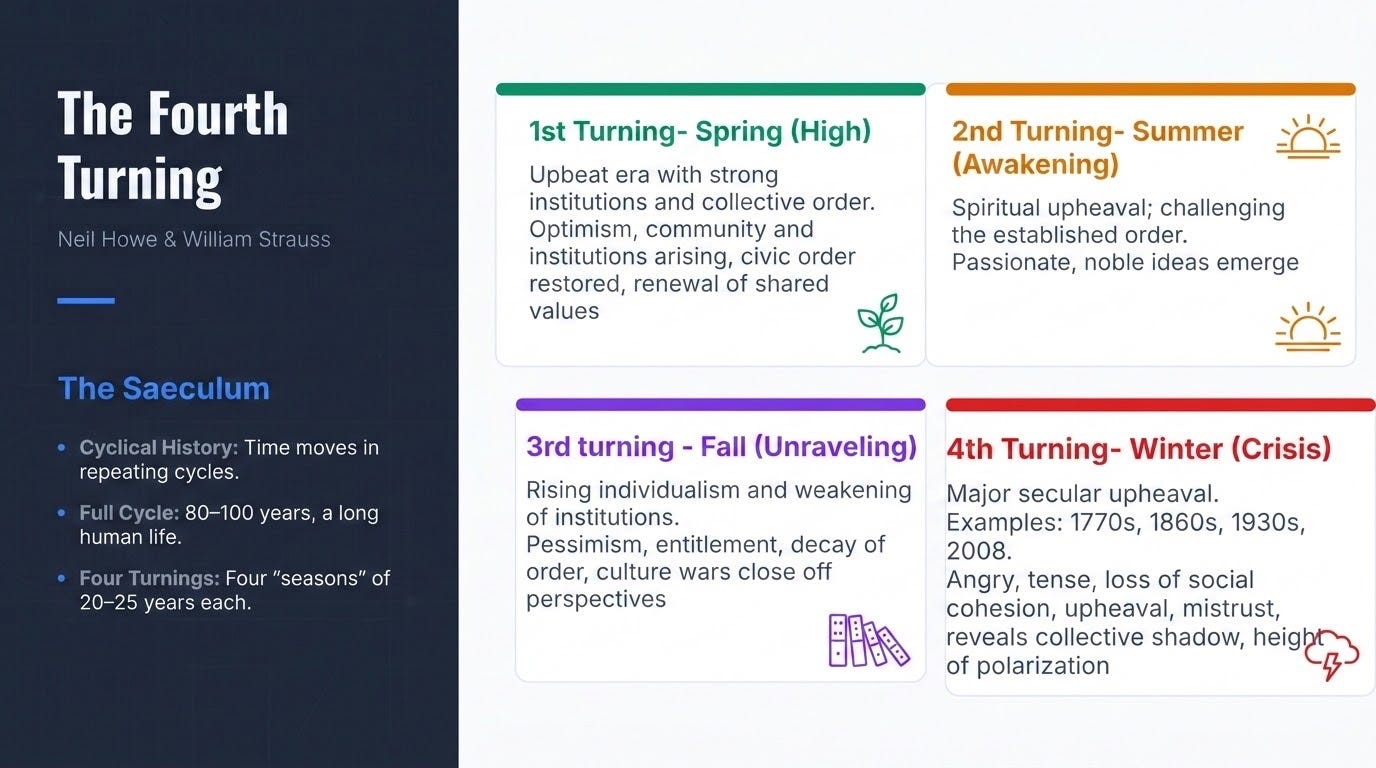
Christine Habib and I co-led a workshop on the nature of change, approaching the issue from two different perspectives. Christine explored its cyclical nature based on Neil Howe’s concept of the Fourth Turning, which argues that American history follows repeated cycles lasting roughly 80 to 100 years, divided into four phases that assess the strength of societal institutions versus individual power. She indicated a reverse relationship between these two elements: when institutions are strong, individualism is weak; conversely, when individualism is strong—like it is today—institutional collapse becomes imminent.
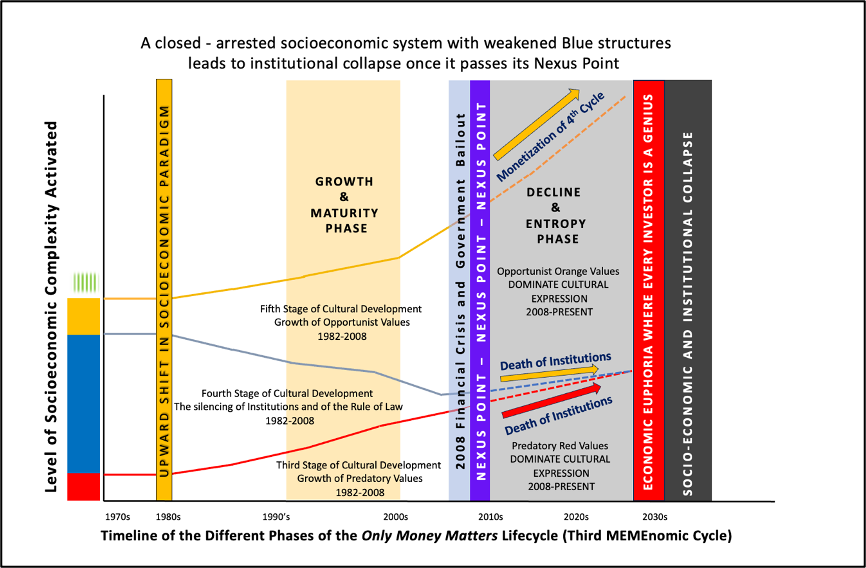
In my portion of the workshop, I differentiated between Cyclical Change and Emergent Change. I introduced two additional models of cyclical change: George Friedman’s socio-economic cycles (40 to 50 years), which coincide with my MEMEnomic Cycles, and his institutional cycles (80 to 100 years), which illustrate what occurs when a socio-economic cycle progresses past its Nexus Point toward institutional collapse (see the graph below). The other cyclical model was based on Ray Dalio’s work regarding the rise and fall of empires, depicting the current decline of the American empire and the rise of China.
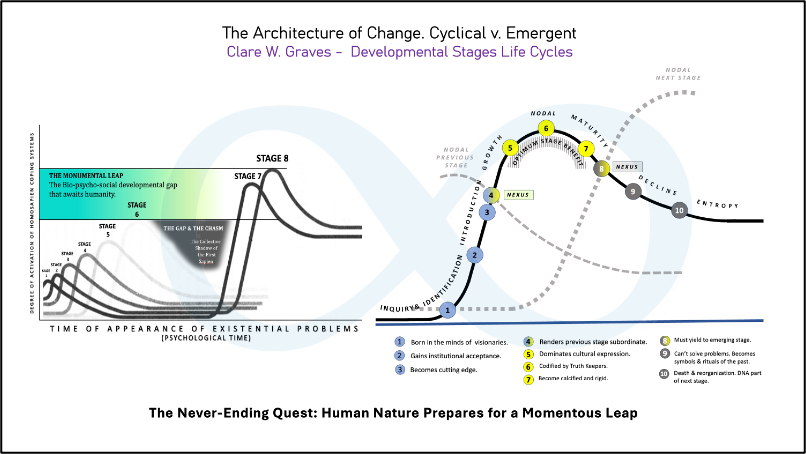
I then introduced Graves’ Emergent Change model, which has been central to my work for over two decades. I emphasized the importance of maintaining our institutions and societal clusters—along the entire spiral—in an open psychosocial state. While this is challenging to achieve, successfully doing so has a profound impact on societal emergence: as the failing system reaches its natural Nexus point, the emergent system can take over and begin to spread its virtues with minimal disruptions, contributing to the evolution of institutions rather than causing their collapse.
Artificial Intelligence & the Future
Craig Hamilton and Adam Leonard delivered keynote speeches about the potential of AI. Craig proposed that this technology offers an unprecedented evolutionary opportunity hiding in plain sight. He outlined a scenario in which machines take over most tasks currently performed by humans, viewing this as a new leverage point to create a flourishing, integrally led society. He detailed how integral leaders can guide the emergence of this utopia.
Adam’s presentation provided an insider perspective, given his leadership role at Google’s DeepMind. He presented a futurist view of “magical technological powers” defined by forthcoming advances in cybernetic augmentation, nanotechnology, and synthetic biology, which will allow humans to live beyond previously imagined timeframes. These changes bring key polarities and moral dilemmas, according to Adam. He believes there will be losses and gains, failures and triumphs, grief and gratitude. He posed critical questions: How do we, as a community, handle the imminent transhumanist wave? Are we biased toward interior evolution while wanting exterior evolution to remain static? What does it feel like to see ourselves as a transitional species, and what will emerge next? He concluded with a recent quote from Demis Hassabis, CEO of Google’s DeepMind: “We are at the foothill of Singularity.” This quote resonated with me for two days and I used it to begin my keynote presentation on a different Singularity: Planetary collapse and how to build collapse resilience.
Human Exceptionalism and Gaian Intelligence
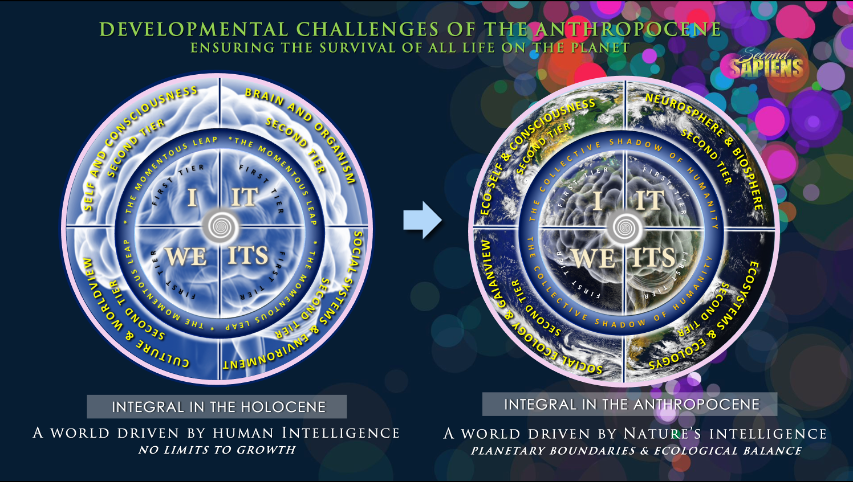
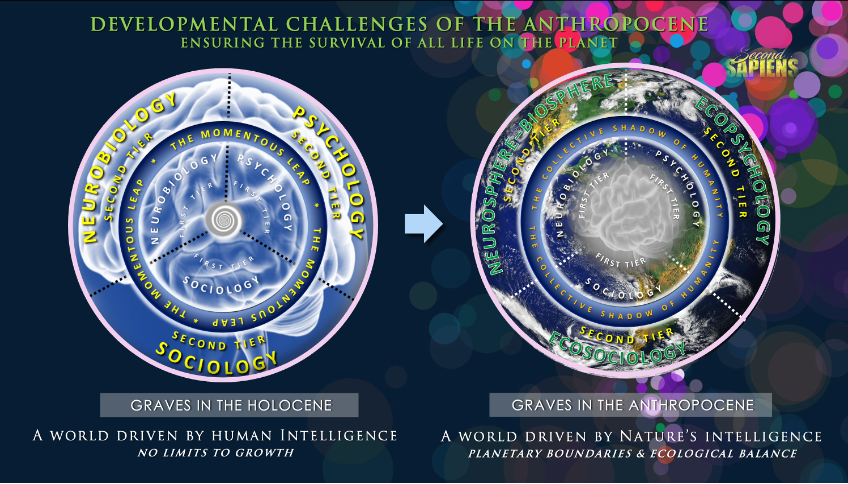
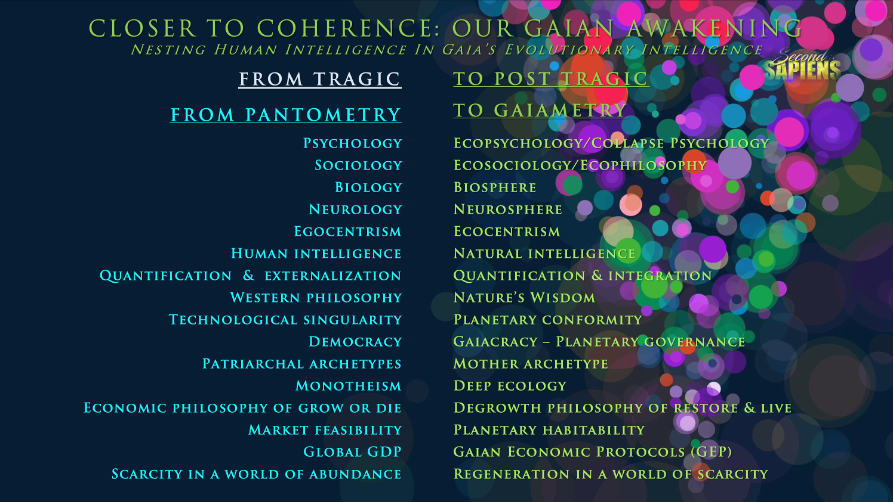
My keynote primarily focused on the themes of my latest book, Second Sapiens, and the necessary shift both of our models must undergo to understand the dynamics that have led to our tragic world. I discussed the critical transition phase and what a post-tragic world might look like considering the planetary degradation and ecological collapse we have inflicted on our planet. This differentiation centered around the idea that our ascendance into the fifth stage Orange system has led us to mistakenly believe that human intelligence surpasses natural intelligence. I argue that transcending the former and integrating it within the latter is our species’ best chance for survival.
Below are images from my presentation that illustrate the shift our models must embrace as we transition from the Holocene Epoch, driven by human intelligence, to the Anthropocene/Gaian Epoch, guided by natural intelligence.
I concluded my keynote with a warning about the limitations of AI, which cannot derive data and knowledge from a future that relies on a far more complex form of science emerging from the eighth stage of development (Turquoise). Wilber often refers to this as the “broad sciences,” commonly understood as the complex adaptive systems of life science. According to researchers in this field, we are at day zero in comprehending its complexity.
Tom led the closing ceremonies with heartfelt reflections on the experiences shared throughout the conference, emphasizing the integration of what we learned, felt, and meditated upon. Many participants noted a significant shift within the community toward embracing systems thinking (LRQ), which was music to my ears. A profound sense of gratitude filled the room as we acknowledged the importance of these gatherings and the vital role they play in our unwavering quest to explore the depths of the human condition. Together, we reaffirmed our commitment to this journey, knowing that each step forward brings us closer to understanding ourselves and each other with reverence to the planet on which we live that makes it all possible.