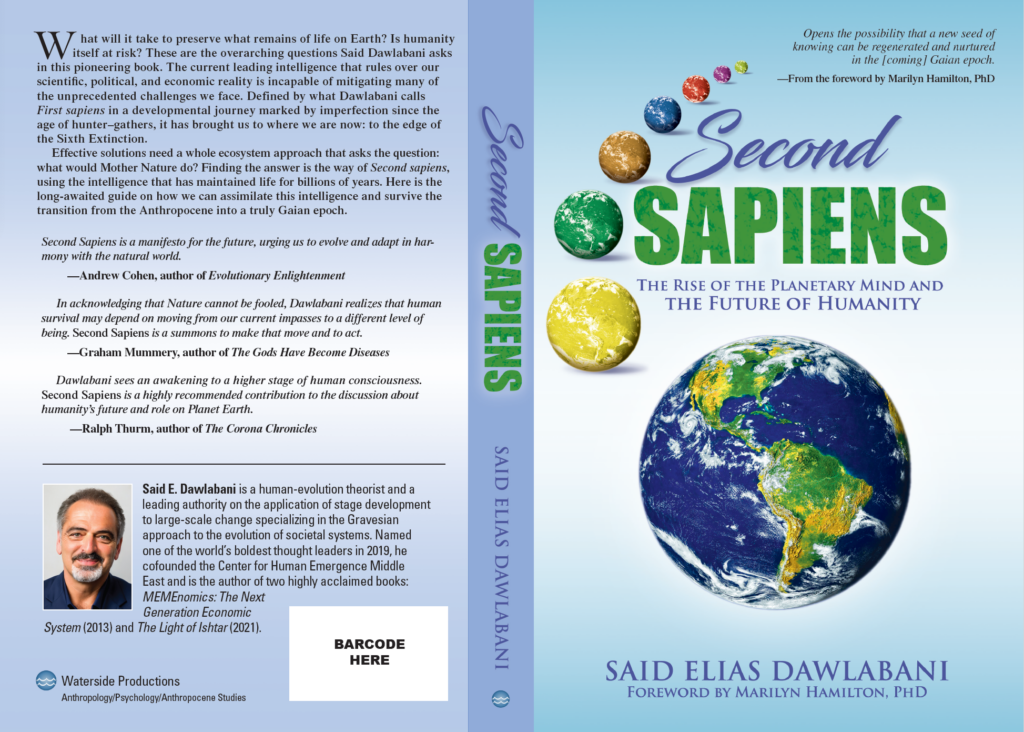
Yuval Noah Harari’s Sapiens captivated millions, and his 10th-anniversary edition, featuring The End of Homo Sapiens and new Afternotes, prompts critical reflection. Having been invited by a colleague to weigh in on these latest insights, this analysis expands upon my initial feedback, contending that Harari’s vision for humanity’s future, while provocative, often overlooks crucial dimensions of human psychological development.
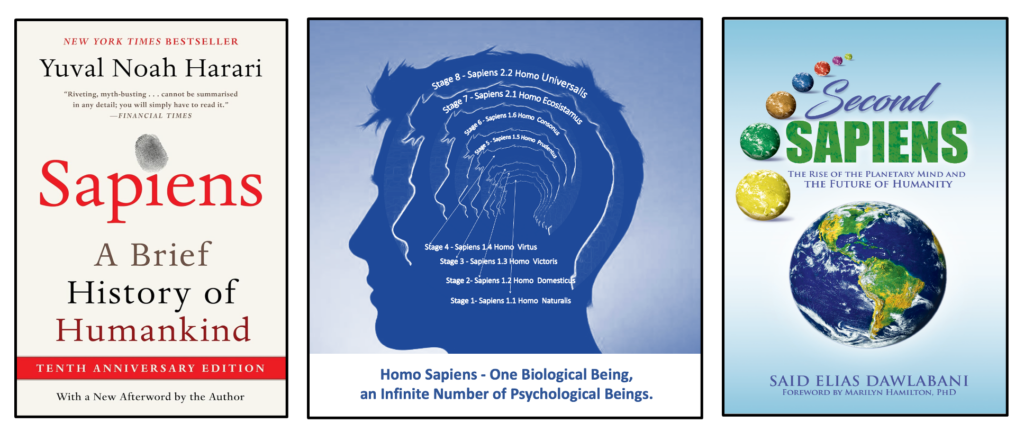
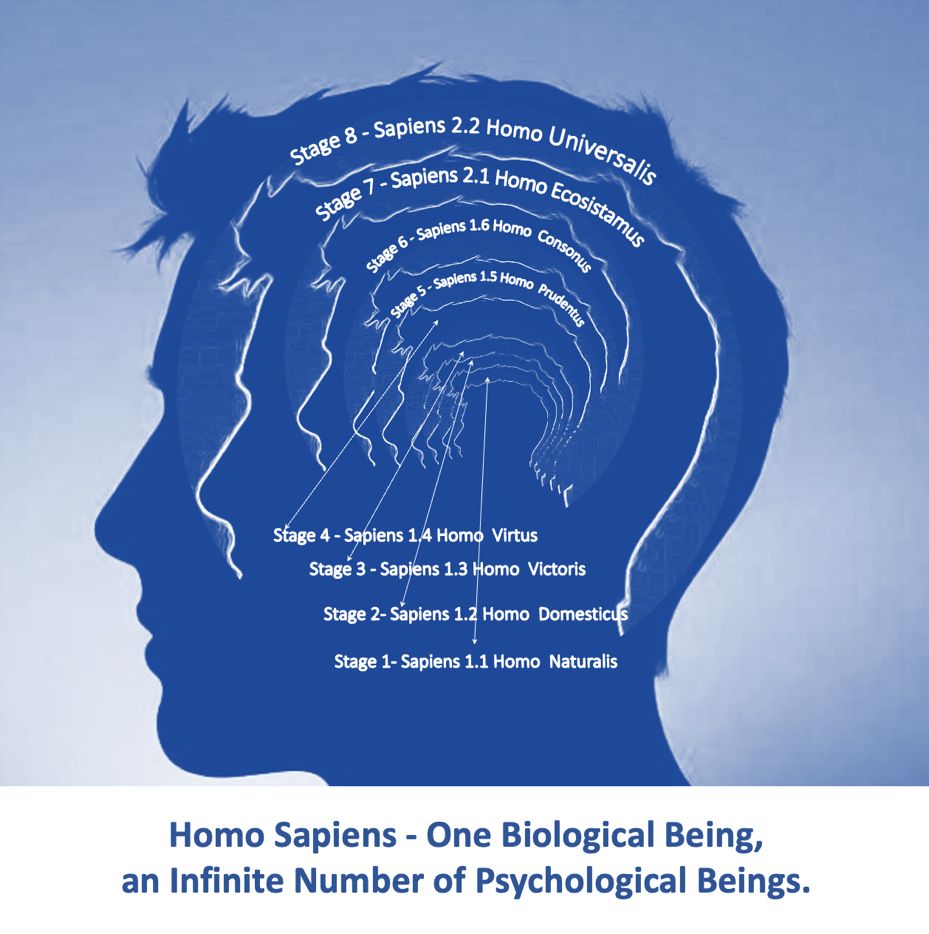
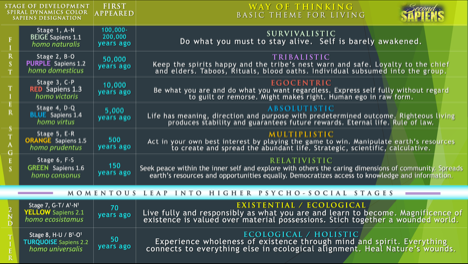
Harari’s assertion that humanity has reached its biological limits, necessitating a new species, is sharply challenged by developmental psychology. Experts like Clare W. Graves, whose research underpins much of my own work, illustrate that Homo Sapiens has remained biologically consistent for 200,000-300,000 years. During this vast period, Graves identifies eight stages of psychological evolution, suggesting that while our biological form endures, our psychological potential remains boundless. Far from ending, humanity, psychologically speaking, is merely emerging from its infancy, continuously activating latent brain capacity as we ascend to higher developmental stages.
Regarding natural selection versus intelligent design, Harari posits Darwinian evolution as the zenith of humanity’s journey. Yet, he appears to bypass compelling research from evolutionary biologists such as Bruce Lipton and David Sloan Wilson, who present cooperation, not competition, as the primary driver of evolution. Harari argues that our future lies in scientific intelligent design—not divinely ordained, but engineered through biological, cyborg, and inorganic means.
However, his examples for biological/genetic advancement often draw from simpler organisms, seemingly neglecting the complex interplay of environment and mind when applied to humans. Harari attributes our scientific stagnation to species limitations, yet this perspective might instead reflect the confines of a specific developmental stage of the mind—what I identify as stage 5, steeped in Newtonian science. The advanced scientific paradigms he envisions actually correspond to humanity’s stage 7 development, not a new species entirely.
Similarly, bionic intelligence, while beneficial as a supplement (e.g., prosthetics, hearing aids), receives a narrower interpretation. Harari’s characterization of computers and cellphones as bionic extensions overlooks their profound psychosocial impact, contributing to isolation, tribalization, and institutional fragmentation. Moreover, the concept of a “bionic collective brain” isn’t novel; philosophers like de Chardin (noosphere) and scientists like Howard Bloom (global brain) have long explored collective intelligence, often accessible through meditation, altered states, or expanded consciousness. These deeper forms of intelligence, within my developmental model, belong to stage 8, again pointing to an evolution of *Homo Sapiens*, not its replacement.
His third category, inorganic intelligence, is a focal point of my own critique, detailed in Second Sapiens. The notion of continuously learning machines, or AI, inherently carries significant risks. A minor data misinterpretation, seemingly innocuous in an AI’s first iteration, could amplify exponentially over thousands of cycles, leading to dangerous deviations without crucial human oversight and ethical checks. Fundamentally, AI is restricted to mining existing information. When tackling existential threats like climate change, where much of the underlying science is nascent, human-led research and hypothesis formulation remain indispensable. AI cannot “mine the future” or accurately predict it when the necessary foundational science for its programming and training is still being established.
While I concur with Harari’s observations on technological singularity and its potential to surpass current human states, I diverge on the implications. Such advancements, from a developmental standpoint, need not signify the end of our species but rather an accelerant to higher stages of psychosocial existence. The caveat, however, is that this technologically-driven evolution, moving at speeds far outstripping collective human and cultural learning, risks creating profoundly imbalanced higher states, disrupting the 200,000-year patterns of human emergence.
Harari’s Afterword on Frankenstein’s Prophecy reveals similar blind spots, portraying the scientific quest as an unstoppable force, seemingly absolved of responsibility for its discoveries. This stance, which assumes science is inherently benign, overlooks the potential for unchecked scientific pursuits—often fueled by modern technology—to inflict immense damage. My own work traces the ecological crisis to this very scientific mindset, one that has consistently ignored the unforeseen consequences lying beyond its immediate conscious awareness.
In The Animal that Became God, Harari again demonstrates a lack of awareness regarding developmental stages. He frames “Homo Sapiens as God” as the pinnacle of our journey, a representation of the 5th stage of mental development—driven by objective analysis and scientific discovery, placing humanity atop the evolutionary ladder. His justification for needing a new species to “save us” stems from this constrained view. Physics, however, progresses beyond Newtonian models (stage 5) to relativity and quantum theory (stage 6), then to systems thinking and complex adaptive systems (stage 7), culminating in complex adaptive systems of life (stage 8). These are all evolutions *within* Homo Sapiens, propelled by higher purpose and consciousness, transcending the reductive “Newtonian god” that Harari implicitly presents as humanity’s ultimate state.
Harari’s concluding remarks in the tenth edition, acknowledging global challenges since Sapiens’ 2014 publication, parallel the opening of my own book, Second Sapiens. Both works identify a systemic failure among leaders to address existential planetary issues. However, where Harari’s Homo Deus (2017) envisions a transition to a data-centric society, placing ultimate power in AI—a manifestation of the 5th stage’s scientific/algorithmic mind—I see information run amok. Driven by profit, this path risks derailing human progress as much as it promises advancement.
Ultimately, Harari’s historical and species contextualization often lacks an informed perspective on the psychosocial and spiritual dimensions of human existence. He tends to conflate organized religion with our inherent spiritual nature, thereby dismissing a foundational aspect of what it means to be human. He exemplifies a “human exceptionalism” paradigm that positions stage 5 Sapiens as the evolutionary apex, precluding the recognition of higher psycho-socio-spiritual expressions. His scientific arguments, advocating for a data-centric god over human-centric life, lack the nuanced understanding derived from extensive studies of the human mind and ongoing brain research.
Harari appears to relegate consciousness and evolutionary thought to laboratory study or machine replication. While he excels as a synthesizer of history, philosophy, religion, and science, his approach to these fields, as integral philosopher Ken Wilber notes, reflects the “narrow sciences” of fifth-stage human development. The world now demands “sciences of higher order,” transcending the material and reductive frameworks of the past five centuries. My hope is that Harari, with sufficient faith in our species, will explore these higher stages of Sapiens’ development in his future writings.