All posts by Said E. Dawlabani

President & CEO of The MEMEnomics Group

Beyond the Holocene Limits of Spiral Dynamics & Integral Theory;

The Clarion Call for Second Sapiens Consciousness.

First published on Substack on June 16, 2025.

As someone who has been deeply immersed in the realms of Spiral Dynamics integral, I’ve dedicated a significant portion of my intellectual life to understanding the complexities of human consciousness and cultural evolution. I’ve seen how this model can illuminate the diverse values and perspectives that shape our world, providing valuable insights into everything from organizational dynamics to societal trends. However, recent experiences and deeper reflection have led me to a critical realization: as powerful as both, Spiral Dynamics and Integral Theory are, they currently lack the necessary frameworks to adequately address the scale and urgency of planetary collapse. We need to evolve; to move beyond the limits of our current understanding and embrace a new form of human intelligence I call Second Sapiens consciousness. This is the new developmental roadmap that will help us navigate the Anthropocene. It involves the transcendence of what planetary system scientists call the Human Exceptionalism Paradigm and the embrace of a New Ecological Paradigm that is far more inclusive in its wholeness.

For those less familiar, Spiral Dynamics, building on Clare W. Graves’s work, outlines a series of stages of development that individuals and societies progress through, each building upon the previous one. Integral Theory, spearheaded by Ken Wilber, offers a comprehensive framework that seeks to integrate different perspectives, including science, philosophy, art, and spirituality. Both models emphasize the importance of understanding and integrating different levels of consciousness for personal and collective growth.

But here’s the core issue: both Spiral Dynamics and Integral Theory, in their prevailing interpretations, were largely developed during a period of relative environmental stability – the Holocene. While they acknowledge the importance of ecological considerations, they tend to treat them as just one factor among many, rather than the defining context for all other aspects of human existence. We’ve been applying frameworks built for a relatively stable world to a world that is rapidly destabilizing. It’s like trying to use a map of a calm lake to navigate a turbulent ocean.

Think about it. Spiral Dynamics and Integral Theory identify stages of development, each with its own strengths and limitations. The “Green” stage, for example, values equality, community, and ecological awareness. But even a well-developed Green perspective can fall short when confronted with the sheer scale and complexity of planetary collapse. Green values can be undermined by a lack of systems thinking, a tendency to focus on local solutions without addressing the systemic drivers of environmental destruction. More importantly, Green is prone to the clever manipulation of the Orange system that has mastered the skill of giving it a bone (greenwashing is a good example), to keep it from realizing its full potential.

Similarly, Integral Theory emphasizes the importance of “waking up,” “growing up,” “cleaning up,” and “showing up” – attending to our inner lives, developing our cognitive capacities, healing our psychological wounds, and engaging in meaningful action in the world. But what if the very ground beneath our feet is shifting? What if the “world” we’re showing up to is on the verge of collapse? Integral Theory, in its current form, doesn’t adequately address the existential threat of planetary breakdown. Having just heard Wilber emphasize the importance of the 4 “ups” at the Integral European Conference, I’d like to add another up: “looking up”. Borrowing from the 2021 political satire movie Don’t Look Up, because doing so will make us see the deep shit we’re in. This is how Graves captured the deficiencies inherent in our exclusive focus on the inner quadrants to the exclusion of our existential reality. He describes it as the ceiling caving in on our heads as we sit in our meditative states contemplating our navel. The “ceiling caving in” are the planetary issues he identified as early as 1974.

This isn’t to say that these two models are irrelevant. Far from it. They provide essential tools for understanding the diverse values and perspectives that shape our responses to the environmental crisis. They can help us identify the limitations of different approaches, from the materialistic worldview of Orange to the traditionalism of Blue and the destructive behavior of Red. But we need to go further. We need to evolve beyond the limits of our current understanding and embrace a new level of consciousness – what I’m calling Second Sapiens consciousness.

Second Sapiens consciousness, as I envision it, is characterized by several key features:

  1. Planetary Awareness: First and foremost, it’s a deep and visceral understanding of the interconnectedness of all life on Earth and the fragility of the Earth’s systems. It’s not just an intellectual understanding, but a gut-level awareness that our actions have profound consequences for the entire planet. It’s what Joanna Macy calls “ecological self” – a sense of identity that extends beyond our individual selves to encompass the entire Earth community.
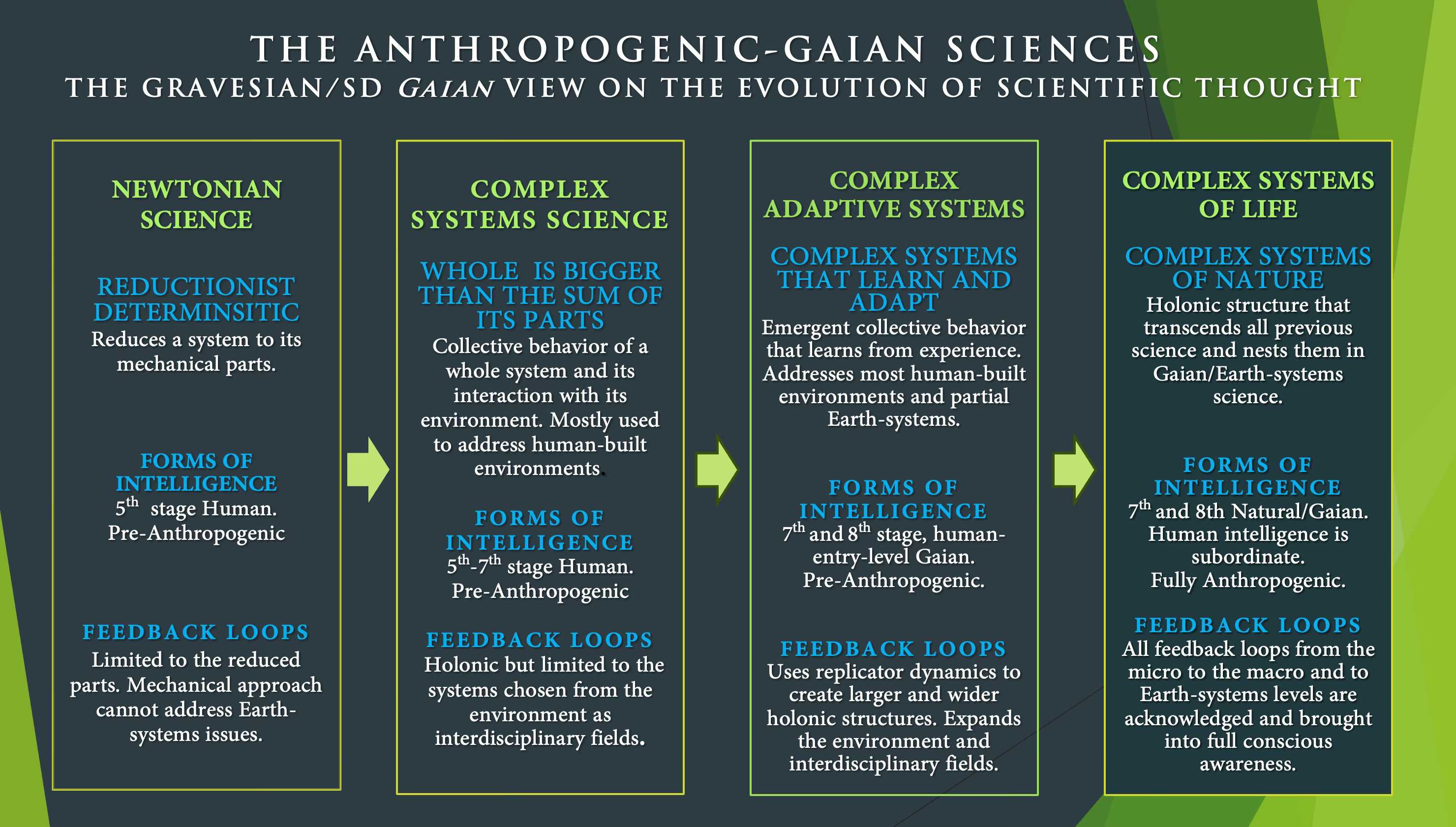
  2. Systems Thinking: Of life that is. Second Sapiens consciousness requires a capacity for complex systems thinking. We need to move beyond linear cause-and-effect thinking and embrace a more holistic understanding of how different systems interact and influence each other in a dance that seeks ecological and planetary balance. We need to be able to see the feedback loops, the tipping points, and the emergent properties that characterize what I call the Gaian sciences defined by the totality of the complex adaptive systems of life.
  3. Natural Intelligence: It’s about learning how to listen to and learn from the wisdom of nature. This involves recognizing the inherent value of all life forms, not just those that are useful to humans. It also involves embracing indigenous knowledge and traditional ecological practices that have sustained communities for centuries.
  4. Existential Courage: It’s about having the courage to face the enormity of the challenges we face without succumbing to despair or denial. It’s about acknowledging the possibility of collapse, while also holding onto the hope that we can still create a more sustainable future. It also means finding the resilience to keep acting in the face of uncertainty and setbacks.
  5. Ethical Responsibility: Second Sapiens consciousness implies a deep sense of ethical responsibility to future generations and to all life on Earth. It’s about recognizing that we are not the owners of the planet, but rather its custodians. We have a moral obligation to leave the Earth in a better condition than we found it.
  6. Transcending Anthropocentrism: Ultimately, Second Sapiens consciousness requires a transcendence of anthropocentrism – the belief that humans are the center of the universe and that all other life forms exist solely for our benefit. It’s about recognizing that we are just one species among millions, and that our fate is inextricably linked to the fate of all other species.
So, how do we cultivate Second Sapiens consciousness within the frameworks of Spiral Dynamics and Integral Theory? I believe it requires a deliberate effort to expand the scope and deepen the understanding of these two models. Beyond Spiral Dynamicsintegral, lies Spiral Dynamics Gaian, and here are some specific steps that will get us there:

  1. Integrating Planetary Boundaries: We need to explicitly integrate the concept of planetary boundaries into Spiral Dynamics and Integral Theory. This means recognizing that crossing these boundaries poses an existential threat to human civilization and that all human development models, not just these two, must be nested in this larger holonic structure without which life itself is not possible.
  2. Nesting the Green Stage in Gaian intelligence: The Green stage needs to be expanded to incorporate a more sophisticated understanding of ecological systems and the systemic drivers of environmental destruction. We need to move beyond the labeling of the stage as the “mean green meme” that equates to deconstructionism and surface reactions and recognize that without empowering its healthy more complex manifestation, our movement to Second Sapiens consciousness will be greatly impaired.
  3. Re-evaluating the Yellow Stage: This stage, which emphasizes systems thinking and holistic integration, holds the key for fostering Second Sapiens consciousness. However, we need to ensure that a new Yellow perspective is grounded in a deep understanding of the much higher holonic structure of planetary realities and ethical responsibilities.
  4. Integrating Indigenous Wisdom: Indigenous knowledge and traditional ecological practices offer invaluable insights into sustainable living and ecological harmony. This is the re-embrace of the simplicity that existed in the Purple stage while using best practices and lessons learned in our journey from the Red to Green stages of our First Sapiens existence. It is what I call the brain-heart-soul syndicate that defines the models on the other side of the Holocene.
  5. Embracing the Dark Side: Spiral Dynamics and Integral Theory tend to focus on positive development and integration. We are swimming in positive psychology that ignores everything negative. Second Sapiens must acknowledge the shadow side of human consciousness and the destructive tendencies that have led us to the brink of planetary collapse. This involves facing our collective traumas and working to heal the wounds that have driven us to exploit and dominate the natural world.
  6. Cultivating Existential Resilience: As we confront the challenges of the Anthropocene, we need to cultivate existential resilience – the capacity to face the possibility of collapse without losing hope or succumbing to despair. This involves developing practices that foster inner strength, connection to community, and a sense of meaning and purpose in the face of uncertainty. The approach is that of humility that acknowledges our misuse of the world and its precious resources as we embarked on a self-aggrandizing, insatiable First Sapiens journey that placed at the mercy of Mother Nature that has become far less merciful towards our species.

It won’t be easy to evolve to Second Sapiens consciousness, because change can hurt. It requires a willingness to challenge our deeply held beliefs, to confront uncomfortable truths, and to embrace new ways of thinking and acting. But it’s not an option; it’s a necessity. If we are to have any hope of creating a sustainable future for ourselves and future generations, we must move beyond the limits of our current models and embrace a new level of consciousness – a consciousness that recognizes our interconnectedness with all life on Earth and our responsibility to protect the planet that sustains us. I am dedicating my work now, and in the future, to doing just that. Welcome to Spiral Dynamics Gaian and Second Sapiens consciousness.

Like!
5

Ex Machina ad Naturam; 

First Sapiens and the Anthropocene 

The First Sapiens is us. The ones whose history came to a quite end in November 2022. This is according to anthropologists and historian Yuval Noah Harari. The basis for his argument was that history, all of history as we know it has become quantifiable and digitizable, storable somewhere in the vast ecosystem of AI clouds, never to be challenged for its voluminous content and its meticulous accuracy. So, if he is right and history has ended, what are we left with? The now? Yes. The future? Yes! Can AI mine that future? No. Can it be trained to do so with its learning algorithms and billions of iterations? NO! Is the future different than the past? Yes. Exponentially so.  

Let me explain.   

We are heading into an era of human existence where a new form of intelligence will be needed, one that is far higher than anything homo sapiens has known. It’s the only form of intelligence that will save us and what remains of life on the planet. Unlike the minds that drove the First sapiens to built better weapons, better shelter and better living conditions, the new intelligence examines the ethos of these historic endeavors to determine if and how they have diminished our planet’s resilience and her ability to ensure the continuity of life. This is Gaian science, an entirely different level of scientific exploration which has remained in a dormant state that still hasn’t been defined, vetted, or validated. It is exponential in nature and it defies all existing scientific methods. It is a new form of planetary science that must examine the degree to which the First sapiens and his insatiable appetite for the modern life has damaged our planet’s ecology. It is the study of ecological collapse at the planetary level that moves at exponential speed and no algorithm or AI model created by the minds of First sapiens has the capacity to understand.       

Technology solutionists today believe that the refinement of their innovations will help us revolutionize our future. That is the view of the optimistic, brilliant, yet limited mind of the First sapiens. Second Sapiens, those who have a planetary-systems view of the future remain skeptical about how much digital technologies in their current form and content can contribute to stabilizing a world defined by mega-scale systems and exponential change. Nothing explains the binary nature of First sapiens better than the digital universe it has created. Information, which is the bloodline of the digital age in its elemental form, is binary. Computers store and process data using bits and bytes that can only be in two states: 0 or 1. The binary system has no innate intelligence; it merely allows for efficient manipulation and transmission of information that makes all digital devices from smartphones to supercomputers operate the way they do. Algorithms that run the world—from the largest supply chain spanning the globe to the world’s biggest financial trading platforms handling billions of dollars’ worth of transactions a day—are all encoded using binary sequences.

The digital age that has disrupted so much of our lives, for better or for worse, is fundamentally built on binary information storage and processing. It is the different combinatorials and iterations, the creative sequential and algorithmic programming, that give us the rich complexity of the world and its ever-expanding technology ecosystem as we know and experience it today. But what happens when the most advanced form of AI perceives patterns or objects that are nonexistent and altogether inaccurate? What happens when the computer models designed to help navigate the Anthropocene must do so with insufficient data from the higher-complexity science that is proprietary to that stage of development? Why do computer models still fail accurately to predict the annual rate of the rise of global temperature and of ecological collapse and how quickly polar ice is melting?

Based on past experience, there is little doubt that we can work out the bugs in the current systems of knowledge. We will find AI-based cures for all types of diseases by expediting the processing of genomic data and creating tailored treatment plans unique to each individual. But how do we know what the bugs are in a system in which its data is of a completely different order and remains emergent, changing unpredictably in real time? It took scientists over twenty years to map out the human genome, which makes it possible for AI to mine that data in a fraction of the time it took researchers to uncover it. What Earth-systems knowledge base can programmers use to establish reliable patterns that AI can mine so we can predict our future within reason? Unlike the current ways AI gathers data, will programmers be able to train their models to gather data from the future—data that doesn’t yet exist? AI could not create those tailored treatments derived from the genomic knowledge base if it weren’t for the extraordinary worldwide commitment to fund and support the Human Genome Project for over two decades. Similarly, AI’s role in helping us resolve problems in the Anthropocene epoch must be proceeded by investments and long-term commitments intended to quantify the nature of Anthropogenic ­– Gaian sciences. 

Much of this new science is yet to be uncovered, and, due to its complex and highly interdisciplinary and collaborative nature, patterns of its emergence remain greatly unpredictable. This becomes a challenge to computer programmers attempting to train their data models to follow identifiable patterns when the science that creates patterns has remained beyond quantification and far beyond the linear and binary grasp of First-sapiens intelligence. Due to what remains unknown in the Anthropocene, would computers hallucinate answers the way ChatGPT and other AI generative models do today, and would such hallucinations create more chaos and misinformation that would derail the upward progress we’ve made in moving the needle on the Gain sciences learning curve? If we acknowledge this as our new reality, then the question for technology solutionists becomes, How can we build predictive training models in the form of machine learning that help address Anthropocene issues from a knowledge base that has been greatly shaped, defined, and constrained by the deficient motivations of the First sapiens?  

I found two possible answers to that question in the work of two individuals who are not technology solutionists but think in systems. The first was from Harari who was quick to qualify what he meant by the end of human history based on his own perception of the evolutionary stages of Homo sapiens. In his 2017 book, Homo Deus: A Brief History of Tomorrow, Harari argues that we have sidelined deo-centrism, the worship of an outer god, in favor of homo-centrism, the worship of ourselves, and that the next stage of evolution would sideline homo-centrism in favor of data-centrism. In interviews and lectures he has given since the release of the different large language models, Harari defends his views on the end of human history by claiming that the operating system of human culture is language. It is from language that we have created human narratives such as myth, law, art, and science, and these are the things that build civilizations. By gaining mastery of language, Harari believes that AI has acquired the master code to human civilization. In some sense, this development could represent what has long been feared and debated: a concept known as the technological singularity in which machine intelligence surpasses human intelligence and forever changes the trajectory of our future. 

Unlike past narratives depicted in science-fiction movies, large language models are not violent machines that subjugate human civilization through blood and gore. Rather, they do it through soft skills that affect the mind. They do it by telling alternative stories generated by their algorithms that first and foremost seek to maximize profits and valuations for the companies that create them. The end of human history based on this data-centric narrative is far more dystopian than science fiction can imagine. It will be brought about by us, disintegrating from within. Generative AI, like its younger kin, social media, will continue to exploit our weaknesses, our biases, and our addictions. It will continue to assemble language that vastly expands our social and political polarization, undermines our mental health, and unravels our democracies. Without wise regulatory structures that see through the mirage of technology and learn how to transcend and use it wisely, human history could end the way Harari defines it. 

In my work in human and social development, a humanity that is data-centric, in a free-market economy that monetizes data, is nothing more than an extension of free market ethos operating without government supervision. Before large language models, language spoke to different people and different cultures at all stages of development. We fought against the dark forces of the unhealthy side of these stages to unshackle ourselves and move up to higher levels of psychological freedom. This is the nature of the evolutionary process that enables our spirit, our never-ending quest to continue. It does not signify the end of human history; it is the transcendence of First sapiens, more specifically, stage five in First sapiens development that seeks to manipulate the world its reductive sciences and algorithmic modeling.  

In order for us to tap into Second sapiens intelligence, there needs to be a global ecology of wise governance that is in tune with our environmental and digital challenges, and not beholden to the values of the industrial age and neoliberal economics. The ideal candidates for this crucial transition will be those who see the simplicity beyond the algorithmic complexity. Tristan Harris and Aza Raskin, the cofounders of the Center for Humane Technologies, along with the 1,100 technologists who in March 2023 asked our government to place a moratorium on AI development, will be ideal candidates that fill the technology regulation part of that form of governance. Becoming part of that complex adaptive system can transform the end of human history into informational units that serve the Anthropocene. 

Harari’s narrative on the evolutionary sequence of Homo sapiens led me to search the unpublished archives of Clare Graves, the academic behind the model I use in my work. I wanted to explore his views on technology and the role it plays in our psychosocial, evolutionary process. That is where I found the second answer to my question of how we can build predictive training models in the form of machine learning from a knowledge base constrained by the deficiencies of the First sapiens. Unlike Harari, Graves was very cautious in predicting the precise details of our future, especially when that future entails our ascendence into GaianSecond-sapiens intelligence known for its exponentially higher degrees of neurological and psychological activation. Here is the place where we  must examine the failures inherent in the reductive First sapiens sciences that have contributed to ecological collapse.


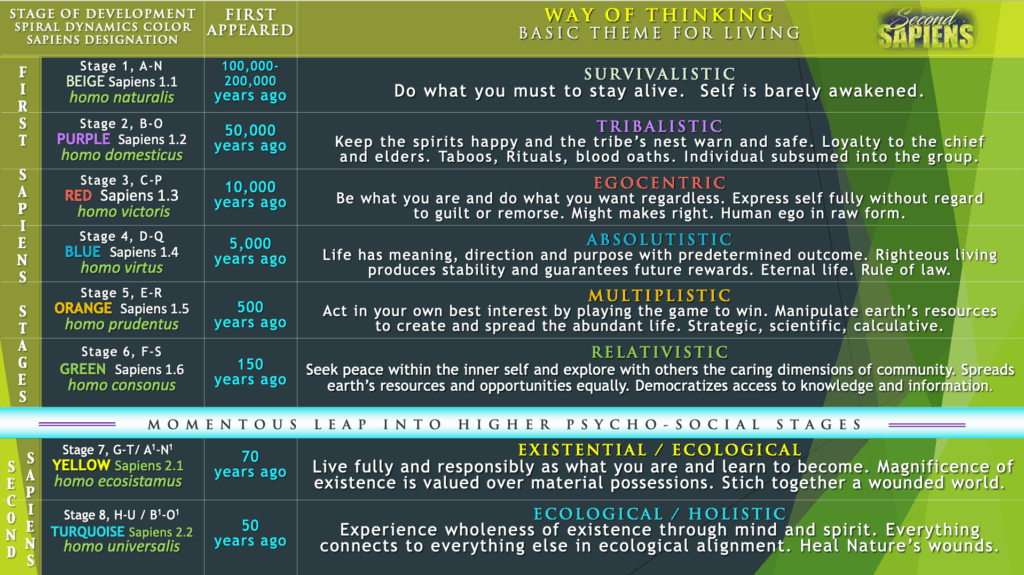
Graves believed that while human development in stage seven in the table above, will represent an exponential growth in intelligence, technology will only be a quantitative extension of the lower stages of development. He made that prediction in the late 1970s.  In examining how his hypothesis has withstood the test of time, one might think that advancements in artificial intelligence and machine learning that were beyond Graves’s grasp at the time would have rendered his thinking obsolete, but that may not be the case. As complex as the digital world is today, with all its complicated iterations and the various creative programming that gives it form, the best it can do is mine knowledge of our human experience that is part of our present and our past. Even with its predictive powers, it cannot give us a reliable, nonlinear representation of the future, especially if that future represents a partial reversal of the past and is defined by an exponentially higher level of psychosocial intelligence that seeks to preserve what remains of planetary life. 

Generative AI and other forms of machine learning will continue to expand our intellectual rigor and raise our cognitive intelligence. They will even help us articulate some Second-sapiens concepts, but these improvements are quantitative and will come at a high cost; that is, the more machine learning we rely on, the more we will lose our uniquely human qualities. Virtues such as emotional and spiritual intelligence become diluted in an ecosystem designed for a data-centric society. We are becoming less and less equipped to handle uniquely human problems at a time when we most need to do so. Ultimately, when the time comes to transcend the ideology of data-centrism, we will realize that the idea of technological singularity in which machine intelligence surpasses human intelligence is a fallacy and that AI will reveal to us what Homo sapiens is by revealing the things it cannot do. 

The more our Anthropogenic reality comes into focus, the more it will become necessary for us to reverse the corrosive aspects of our present and past and create new ways of being and thinking. The intelligence that defines those virtues is just beginning to emerge and will eventually serve as the new reservoir of knowledge in which machine intelligence is recognized for what it is—a utility subordinate to the human wisdom that helps all life forms on the planet survive and thrive.   

Like!
1

The Great Intelligence Divide: Prometheus v. Gaia 

Published on Substack February 22, 2025

For millennia, humanity has grappled with its relationship with the natural world. We’ve been both awestruck by its power and driven to conquer it, often with disastrous results. This internal conflict is beautifully encapsulated in the contrasting myths of Prometheus and Gaia, two powerful archetypes representing fundamentally different approaches to intelligence and our place in the universe. Understanding this conflict – this “Great Intelligence Divide” – is crucial to navigating the challenges of the 21st century.

The Gift of Fire

Prometheus, the Titan who gifted fire (knowledge and technology) to humanity, embodies Promethean intelligence. This is the human capacity for relentless innovation, for pushing boundaries, and for reshaping the world to our will. It’s the brilliance that drives scientific breakthroughs, technological advancements, and artistic expression. It’s the fire that fuels human progress. But, as the myth reveals, this fire is a double-edged sword. Prometheus’s defiance of the gods brought him immense suffering, a testament to the potential for unchecked ambition and the unforeseen consequences of tampering with the natural order.

Mary Shelley’s Frankenstein serves as a chilling modern parable. Victor Frankenstein, driven by Promethean ambition, creates life but ultimately unleashes chaos and destruction. His hubris, his relentless pursuit of knowledge without considering the moral implications, results in tragedy. This cautionary tale highlights a critical flaw in Promethean intelligence: its inherent tendency towards hubris, its willingness to prioritize advancement over ethical considerations, and its inability to account for the dark side of its actions. The consequences of this imbalance are evident in our modern world: climate change, resource depletion, and widespread social inequality are all, at least in part, the result of a Promethean approach that values progress above all else. The Manhattan Project, detailed in American Prometheus, provides further evidence. J. Robert Oppenheimer’s creation of the atomic bomb exemplifies the immense power—and moral responsibility—inherent in Promethean intelligence. His lifelong struggle with the ethical implications of his creation underscores the critical need for a more inclusive approach.

The most dangerous form of Promethean intelligence today is present in the ecosystem of Silicon Valley and the neck-breaking speed with which its leaders want to develop and monetize Artificial Intelligence. The digital economy and all its peripheral expressions are the prime example of the binary nature of human intelligence that places itself above all other intelligences, ignoring the dark side of its own actions. In spite of calls to place a moratorium on further AI development, Silicon Valley has moved forward with impunity, ignoring the voices of reason and the greater ecology in which all human activity exists.

The gift of fire has ignored the curse of its own burning embers.

Transcending Human Intelligence

There’s another way of understanding intelligence, a way that stands in stark contrast to the Promethean model. It is Gaian intelligence. Gaia, the Earth goddess, personifies the wisdom of the natural world, the inherent balance and interconnectedness of all living things. Gaian intelligence isn’t about conquering nature; it’s about understanding, respecting, and working with it. It’s a holistic, systems-based approach that recognizes the inherent value of biodiversity, the cyclical nature of resources, and the delicate equilibrium that sustains life on Earth.

Where Promethean intelligence often prioritizes linear progress and reductionist thinking – breaking down complex systems into smaller, manageable parts – Gaian intelligence embraces complexity, recognizing the intricate web of relationships that connect every element of the ecosystem. It prioritizes interconnectedness over isolation, understanding that damage to one part of the system inevitably affects the whole.

The fundamental difference between these two forms of intelligence lies in their relationship with nature. Promethean intelligence views nature as a resource to be exploited, a canvas upon which to paint our innovations. It seeks to dominate and control, often disregarding the potential consequences of its actions. In contrast, Gaian intelligence views nature as a teacher, a source of wisdom and resilience. It respects the intricate balance of the natural world and seeks to harmonize human activity with ecological processes.

The current crisis facing humanity – climate change, biodiversity loss, and resource depletion – is a direct consequence of the unbalanced emphasis on Promethean intelligence. Our relentless pursuit of technological advancement and economic growth has pushed the planet beyond its limits, leading to an ecological crisis of unprecedented scale. This is not to say that technological progress is inherently evil, but rather that our approach to progress has been fundamentally flawed, lacking the crucial perspective offered by Gaian intelligence.

Prometheus endowed with Gaian Intelligence.

Moving forward, we must find a way to integrate these two contrasting forms of intelligence. We can’t simply reject Promethean intelligence; technological innovation is crucial to addressing many of the challenges we face. However, we must fundamentally shift our approach, incorporating the wisdom of Gaian intelligence into our decision-making processes. This means adopting a more holistic, systems-based perspective that prioritizes sustainability, equity, and respect for the natural world. More importantly, at the center of every new scientific approach should be the question: What would Mother Nature do? This is the long-awaited leap in the evolutionary trajectory of science that will save us and the planet.

This integration requires a profound shift in our values and priorities. It demands a move away from a purely anthropocentric worldview – one that sees humanity as separate from and superior to nature – towards a more biocentric view that recognizes our interconnectedness with all living things. It means prioritizing long-term sustainability over short-term gains, embracing collaboration over competition, and recognizing the limits of human ingenuity in the face of the vast complexity of the natural world.

The challenge is not to choose between Prometheus and Gaia, but to integrate their wisdom. We need the fire of Promethean intelligence to illuminate our path, but we also need the wisdom of Gaian intelligence to guide our steps, ensuring that our progress is sustainable and doesn’t come at the expense of the planet and future generations. This integration demands a paradigm shift, a move away from a purely reductionist, extractive model of development towards one that is holistic, regenerative, and deeply respectful of the intricate balance of the natural world. Only through this integration can we hope to build a future that is both prosperous and sustainable.

Like!
3